





Is the Success of Scottish Football a Threat to the Union?
Scottish football is not usually the concern of Englishmen. This century, across six games, England has beaten Scotland four times while Scotland has not managed to beat England once. Such is the lopsided nature of the oldest rivalry in international football.
Now, however, Scotland is under something of a resurgence. Qualifying for this year’s FIFA World Cup means Scotland plays in the world’s biggest sporting competition for the first time in 28 years. Beating Haiti 1-0 in the opening game, meanwhile, didn’t just bring the Scots their first World Cup win since 1990, but put them top of their group featuring superstars from Brazil and Morocco.
Even more than England, Scotland has gone mad for the World Cup. By proclamation of His Majesty the King, the Scottish Government confirmed a national bank holiday ‘to mark Scotland’s participation’ in the World Cup. To put that decision in context, England’s genuine achievement of reaching two consecutive European Championship finals in the past five years was not merited with an extra day’s holiday on either occasion.
What’s more, the Scottish team was supported live in the flesh by the Scottish First Minister, who flew out to America, ostensibly for ‘Whisky Talks’. The Prime Minister, by contrast, has not attended an England World Cup match since they won the competition on home soil in 1966. Back then, the Prime Minister Harold Wilson attempted to participate in the half-time commentary, something I can only recommend against today.
All this aggrandising from Scotland passes the point of embarrassment when you consider that FIFA has made the World Cup 50% bigger for this year’s tournament. Scotland is a footballing giant compared to the minnows of Cape Verde, Curaçao, Jordan, Qatar, and Uzbekistan, who have all competitively qualified for the World Cup for the first time. Haiti have never won or drawn a World Cup match before.
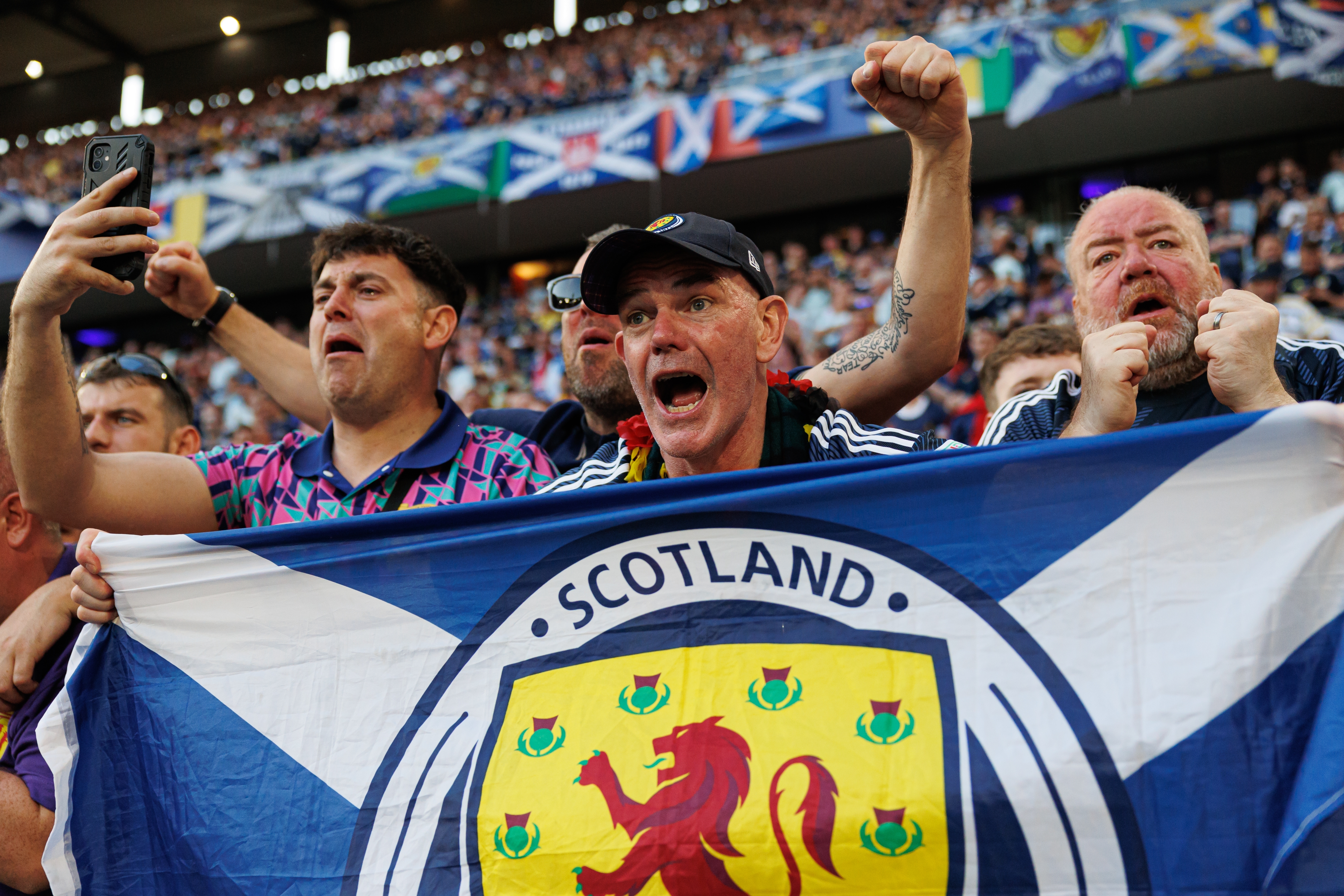
What is perhaps less surprising is the more visceral footballing reaction from Scotland. Unlike England, which has a mass of genteel middle-class fans who quite like supporting the home nations of Wales, Scotland, and Northern Ireland, one could never imagine such joviality returned by Scotland. Dennis Law, Scotland’s joint record top goalscorer, surely spoke for Scotland when he said England’s 1966 World Cup win was the ‘blackest day of my life’.
This anti-English attitude peaked in 1977, when Scotland beat England 2-0 at Wembley. A Tartan Army of 75,000 Scotland fans invaded the pitch at full time, stole clods of the turf, and smashed in the goal posts (not an easy feat). Three hundred people were arrested. ‘Give us an Assembly, and we’ll give you back your Wembley’, the Scotland fans chanted.
Writing afterwards, the Scottish FA annual report concluded: ‘Traditionally, Scots have tended to associate their worth as a nation with the exploits of their football team, and in these days when strong feelings of nationalism sweep the country and protests against repression, real or imaginary, are heard on all sides, this… has produced a situation where a quite unprecedented volume of support for the team is exhibited.’
It need not have ever been this way. The reason England and Scotland play separately is because they got round to inventing football first, and needed someone else to play against. FIFA was only formed in 1904, a full 30 years after each nation had been playing separately.
Playing together could have been a great success. In 1947, the Home Nations formed a ‘Great Britain’ team (featuring Northern Ireland) and thrashed the Rest of Europe 6-1 in a game dubbed the ‘Match of the Century’.
Until the 1960s, England and Scotland jointly sang God Save the Queen before each match. Then, Scotland’s anthem was changed to ‘Scotland the Brave’, a song that celebrates the Scottish landscape. Then it was changed again to ‘O Flower of Scotland’, a song written in the mid-1960s about the Scottish victory over King Edward II in 1314 at the Battle of Bannockburn. This is anti-Englishness baked into football.
Indeed, most young Scots I know do not know the words to God Save the King, primarily, I suspect, because the Scottish football and rugby teams no longer use it. When else do you hear or sing the national anthem in England outside a sports game?
Scottish football, then, may not be a concern for England, but it certainly is for the Union. Scotland may have gone mental for the World Cup; let’s just hope they don’t completely lose their heads, like they did in 1977.