







Great British Poets: Elizabeth Barrett Browning
Today, the Daily Britain is pleased to publish the first of the Great British Poets series by Sarah Fletcher.
First time he kissed me, he but only kissed
*The fingers of this hand wherewith I write,
And ever since it grew more clean and white,…
Slow to world-greetings…quick with its “Oh, list,”
When the angels speak. A ring of amethyst
I could not wear here plainer to my sight,
Than that first kiss. The second passed in height
The first, and sought the forehead, and half missed,
Half falling on the hair. O beyond meed!
That was the chrism of love, which love’s own crown,
With sanctifying sweetness, did precede.
The third, upon my lips, was folded down
In perfect, purple state! since when, indeed,
I have been proud and said, “My Love, my own.”
Sonnets from the Portuguese 38: First time he kissed me, he but only kissed
Elizabeth Barrett Browning’s fame far outstrips her readership. Her fame has been reduced to not only a single poem of hers, but a single line, and the first line at that: ‘How do I love thee? Let me count the ways.’
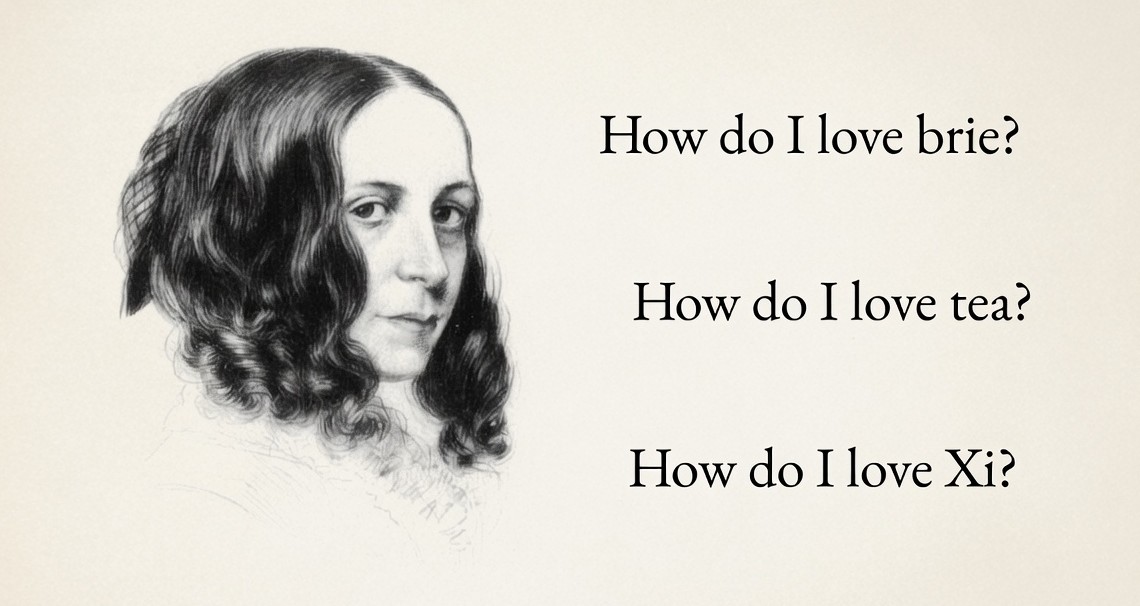
Her widely anthologised sonnet brings to mind forced school recitations and glib Valentine’s Day advertisements. It has been used to sell me cheeses (how do I love brie?), Earl Grey (how do I love tea?), and, worst of all, political ideologies (how do I love Xi?).
It has been used to sell me cheeses (how do I love brie?), Earl Grey (how do I love tea?), and, worst of all, political ideologies (how do I love Xi?)
Poetry is always more than the sum of its parts, but to have one’s legacy memorialised as only the first line of a sonnet may be particularly cruel. Sonnets as a form go through a journey: the ‘volta’, or turn, is where the real magic happens, and the poet poisons or sweetens the poem thus far. Sonnets are poetry that moves. In Barrett Browning’s ‘How do I love thee? Let me count the ways’, the first line is only saved from saccharine sentimentality by the last line, in which ‘if God choose, / I shall but love thee better after death.’ If death is hypothetical, this poem is almost pompous. If death is not, it is an awkward and eerie end to a love poem. As it is, it hovers slightly in the middle, as an optical illusion might switch before your eyes. Is it a rabbit or an old lady?
Barrett Browning remains maligned. She’s ripe for a feminist excavation that other women in history have been gifted; she was perhaps too famous to get the second flush of excitement that Christina Rossetti and even Emily Dickinson were rewarded in the 70s. But her life has the makings of a liberating fairytale that nearly got a happy ending. Elizabeth Barrett Browning was highly educated by her idiosyncratic father who forbade her and her eight siblings from marrying. At 15, she fell ill and lived in quarantine-like conditions in her home in Marylebone. Her ailment has gone through multiple posthumous diagnoses: from epilepsy to Hypokalemic Periodic Paralysis to something psychosomatic. She most likely had an eating disorder, and absolutely had a reliance on opium.
After writing secret letters to the poet Robert Browning, she eloped with him and left England for Italy. She was forty years old, and he was thirty three. It was a huge risk that gave her a literal second lease on life after decades of frailty. Her health had a period of improvement, and she had a child. She and Robert Browning have the rare distinction of being one of the few, if not only, poetry couples to not have imploded.
Sonnets from the Portuguese is a collection of 44 poems, which she wished to present as translations of foreign sonnets to distance the reader from their intensely personal subject matter. In fact, they were originally going to be Sonnets from the Bosnian; the switch has saved us from thousands of undergraduate essays about art during the 90s Balkan conflicts.
This particular Barrett Browning poem is my favourite. It’s split into three kisses, and this three kiss structure works well as a conceit. Kisses are fulcrums that bring the lover closer to the speaker. The poem starts with the hand and graduates to the forehead and then, finally, the lips.
She starts: ‘First time he kissed me, he but only kissed / The fingers of this hand wherewith I write, / And ever since it grew more clean and white.’ This is a self-conscious speaker. It is also a deeply romantic one. He has kissed the fingers that she uses to write, and now, these fingers are writing this very poem. This is a poem sanctified by his lips on her hands. She’s being admired and loved as both a woman and a writer. More than that, there is a recognition that perhaps they both go together.
From then on, ‘oh list!’. She is able to hear the angels. ‘List’ is not a Victorian poetry word. It would have been archaic to the Victorian ear: as dramatic as a ‘hark!’. But it shows that yes, the speaker is swooning. She is swooning back in the days when swooning held water. Perhaps her swooning may have been the issue with her unsteady legacy. Her love is rambunctious to the point of being embarrassing. She is fervent for her husband. She is not shy about throwing in the antiquated for effect. Yet I find this swooning to be Barrett Browning’s strength. These are poems that are uninhibited and then restrain themselves once again.
The second kiss is delivered to her forehead: ‘half-missed, / Half-falling on the hair’. The lover is goofily adolescent. We have a sweet and clumsy image of a tenderness that seems like it should come from the hand of a teenage girl rather than a forty year old woman. And from this near-miss of a kiss, the speaker rejoices that he has given her what is almost a religious sacrament in ‘chrism’. The ‘oh’ from ‘oh list’ devolves fully into the bombastic, poetic ‘O’. But the best kiss has not arrived yet.
The lover finally kisses her lips. It is a kiss ‘folded down / in perfect, purple state’. It is a kiss written by an alien who has read about human interaction and romance without seeing it, and is now only able to receive it. Who folds down a kiss? This language is awkward and strange, and yet, it still describes something perfect.
‘Perfect, purple state’ is commonly read as a reference to royalty. But I have another proposition: Barrett Browning was raised reading Latin. She’d have been aware of Ars Poetica by Horace, where the phrase ‘purple prose’ is first used to describe opulent and excessive verse. I believe she’s poking fun that she got carried away with herself: she got so carried away with love that she, a deeply committed Christian, risks making him a false idol.
She concludes, ‘I have been proud and said, “My Love, my own.”’ As I said earlier, the volta is important to the sonnet; the volta is either the poisoner and the sweetener. Her volta opts for the latter. It is her putting a flag into her lover; it is a humble brag. She wants us to know her lover has made her a better writer, and she is showing us that fact in verse.