




The Renault 16 exposed Britain’s biggest car failure
The Renault 16 created the market for versatile hatchback family cars over sixty years ago. Voted ‘Car of the Year’ in 1965, the 16 was four seasons into a 1.8 million unit, 15-year production run by the time its first true rival, the British Austin Maxi, appeared in 1968.
If the Maxi looked austere, the Renault’s six-window body had a confident and functional, yet rather eccentric, elegance about it. With its rectangular Cibie headlights (which could be adjusted on an external lever to take account of load) it was both unmistakable and timeless. This five-door, five-seater saloon had rear seats that could be folded into multiple combinations depending on the task in hand, including into a makeshift bed.
The 16 was a brave and radical move that represented a huge amount of investment. It had been conceived as a ’lifestyle’ car for an emerging, young, French, post-war middle class who had both money and a certain amount of leisure time on their hands.
Renault had spotted a niche for a saloon that could be used for work and play with the comfort and refinement needed for the long trips sometimes necessary in a large country like France, where road surfaces were still often very poor. On its long travel torsion bar suspension, the R16 had a ride quality that approached the standards set by the Citroen DS but in a less expensive, less complex, and lower maintenance package where even chassis greasing had been eliminated.
Having pioneered disc brakes on affordable cars, Renault went a step further with the 16 by incorporating an anti-lock mechanism on the rear axle. An oddity of the car was that the wheelbase was shorter on one side because of the way the rear suspension was fitted.
Very few cars are truly ‘all new’, but the 16 really was. Its freshly conceived four-cylinder engine, the first in Europe to have a pressure die-cast alloy block for enhanced precision and repeatability of the casting process, featured the then uncommon refinements of an electric fan and a sealed cooling system. Giving less than 60bhp at first, this 1470cc pushrod engine didn’t make a rocket ship out of the not notably light 90mph R16; but it was willing, smooth, and well placed, Citroen style, behind the four-speed gearbox where it jostled for space with the spare wheel in what almost amounted to a front mid-engine position.
Colin Chapman of Lotus soon spotted the potential in this power train package for his mid-engined Europa in 1966. Two years later it would get a dramatic boost in power for the 16TS with inclined valves and more efficient breathing. Along with a modest increase in capacity, these changes took the output to 83bhp and top speed to just over 100mph.
Throughout their run, 16s had a column gear change: they must have been one of the last European cars thus equipped when production at the factory near Le Havre ended in 1980. Five speeds didn’t appear until the quad headlamp TX of 1973 but there were automatic 16s from the late sixties onwards, equipped with the first auto boxes built in France. Meanwhile, the well-intentioned but unlucky Austin Maxi stumbled on, earning some dubious notoriety when John Lennon (a famously bad driver) crashed a white Maxi he had hired for a trip to Scotland.
The facelifted post-1970 Maxis were so much better than those early cars that they almost deserved a new name
The Maxi was not just the last production car of Sir Alec Issigonis (designer of the Morris Minor and the Mini) but also Leyland’s last chance to build a real winner in a section of the market that, thanks to the success of the Renault 16, was rapidly shaping up to be the most bitterly fought of all. Brilliant as a creator of small cars, Issigonis had a way of sucking the joy out of bigger vehicles with his austere I-know-best approach, something all too manifest in the chillingly unglamorous Maxi 1500.
The facelifted post-1970 Maxis were so much better than those early cars that they almost deserved a new name.
In the face of the Maxi’s perceived shortcoming, the R16 just got more and more popular in the seventies. Competitively priced to within a few pounds of its BL rival, it was one of the cars that spearheaded the foreign assault on the British market (64,000 were sold in the UK up to 1974 alone) as an ever-weaker Leyland grappled with poor labour relations and low productivity.
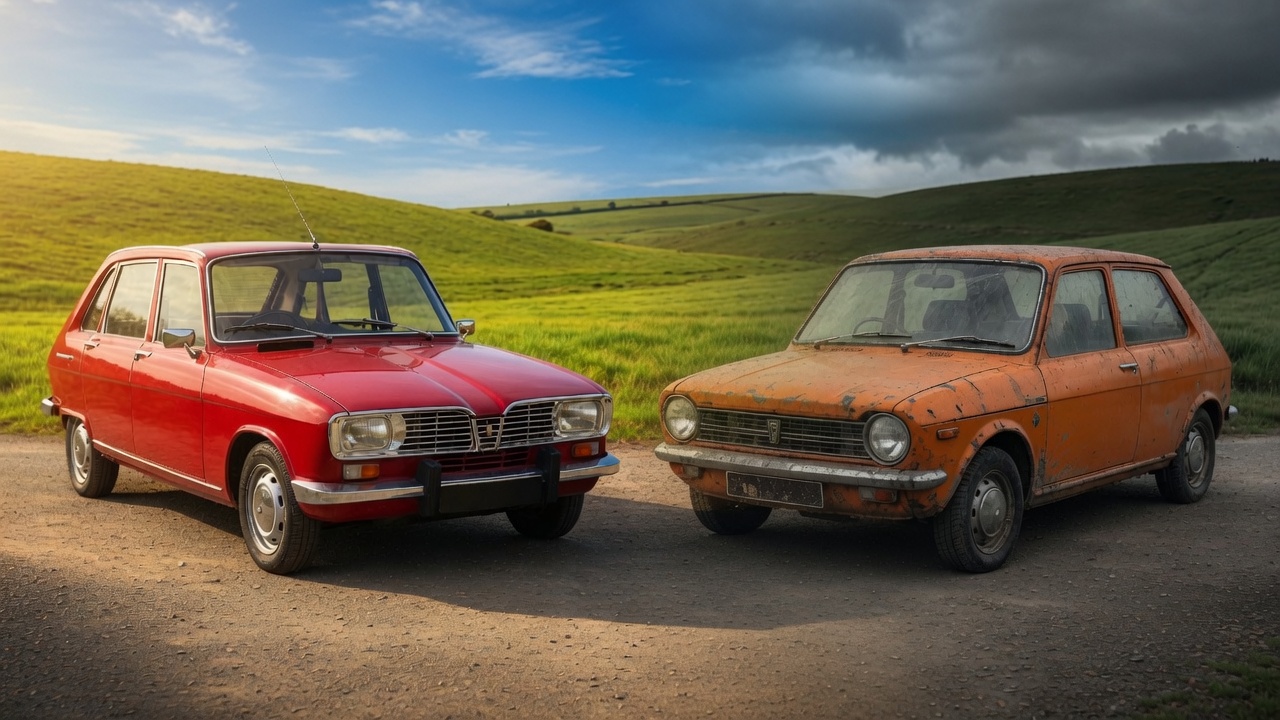
But while the Maxi never achieved anything like the hoped-for sales (412,121 in 12 years) it remained the only real British alternative to the Renault 16: even in the late seventies 30,000 Maxi sales a year could be depended on from a loyal home-market following who appreciated the car for its unpretentious utility.
Having said all that, it doesn’t pay to get too misty eyed about the fate of the Maxi when, in the end, the Renault 16 was a much better resolved and more significant car: a car with charm to burn, created by engineers with a clear vision of what was required and enabled by a management brave enough to let them get on with the job. Management, interestingly, who answered to the French government; the R16, like the Maxi, is the product of a state-owned car manufacturer which just goes to show nationalisation isn’t always a bad thing.