




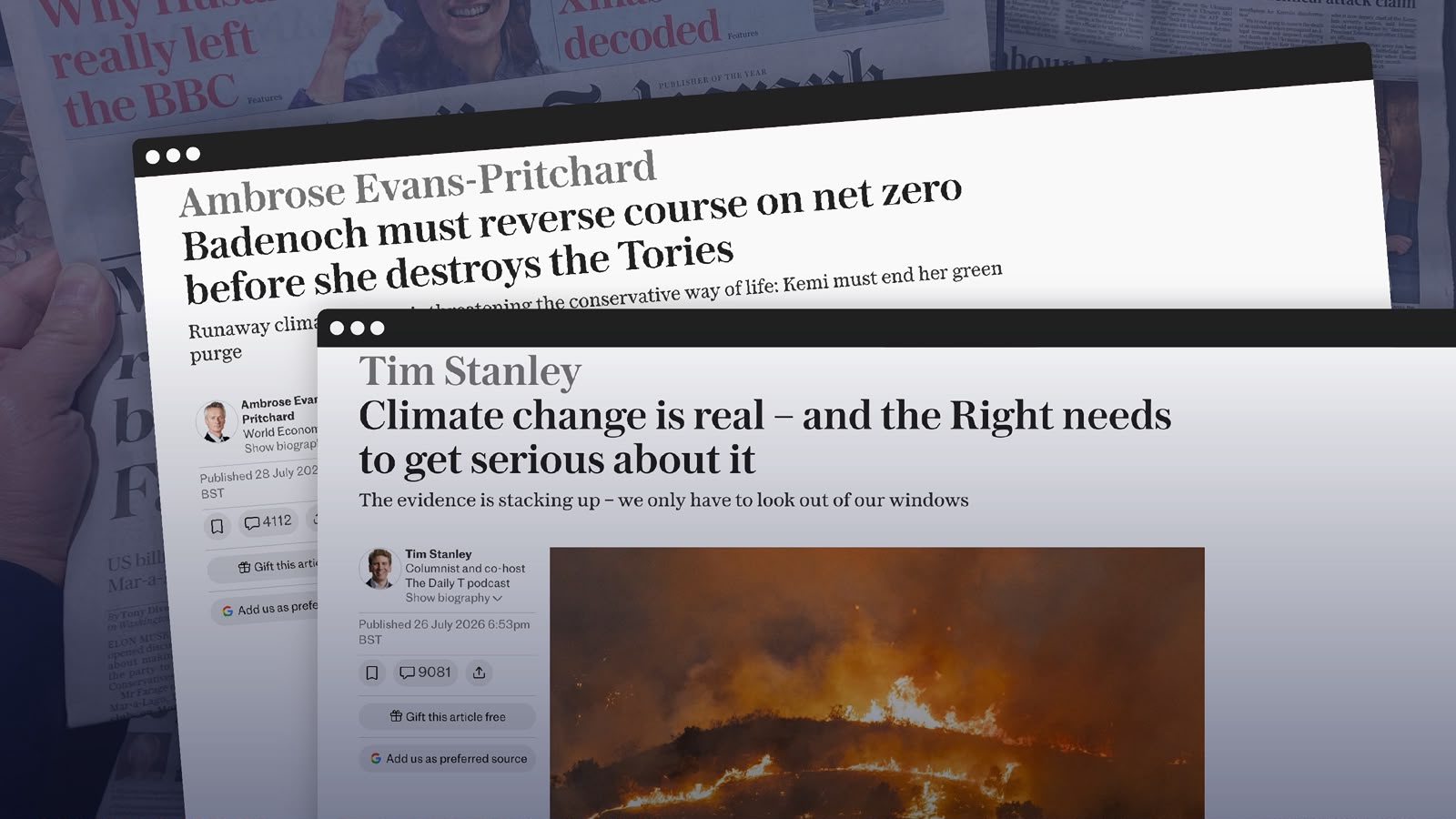

This is a sustained editorial lean against the readers’ own instincts, on climate and on politics
The Telegraph was the house paper of conservative Britain. Everyone knew it. For the best part of a century it spoke for the people who actually keep this country running, the small business owner, the retired officer, the shire Tory. Especially the shire Tory, who read it over breakfast and trusted every word. That paper is gone. What remains carries the same masthead and spends its days lecturing the very readers it once represented.
And this is not slow decay. The sharpest examples all land in the last four weeks.
Exhibit A. Tim Stanley’s column of 26 July: ‘Climate change is real - and the Right needs to get serious about it.’ Stanley tells the ‘angry Online Right’ it is ‘going wrong’ and must accept the climate consensus as settled fact. His evidence? Fires in France, a poor grain forecast, English weather, and Bangladesh.
Almost none of it survives contact with the data.
Stanley claims France historically endured roughly 15 fires a year. The official figure, from the EU’s own wildfire monitoring service, is an annual average of around 90. Out by a factor of six. And before anyone holds up the recent numbers as proof of catastrophe, look at when they climb. The recorded count only jumps from 2019, which is exactly when the service switched on sharper satellites that catch smaller fires the old system missed. More detection, not more fire. EFFIS says so itself, and warns against reading its year-on-year counts as though the method had never changed. This summer is severe; nobody sensible disputes that. But one hot summer is a hot summer, not a trend, and the data does not do the work Stanley needs it to.
Then there is Bangladesh, his chosen poster child for climate victimhood, and here Stanley has picked the one country that demolishes his own case. Cereal production has more than doubled since the 1990s, hitting record highs in 2023 and 2024. Agricultural output has more than doubled alongside it, while GDP per capita now sits at four times what it was 30 years ago. Extreme poverty has fallen from around 44% of the population to single figures. From nearly half the country to a handful. None of that happens without fossil fuels, fertiliser, and mechanisation; the very things Net Zero would price out of reach of the developing world.
He also points to renewables as proof the market has spoken. An industry propped up by subsidy, carbon taxes, and government mandates is not a market outcome. It is a political one. UK wind fails for weeks at a time in winter; ask the National Grid.
So one columnist wrote one weak column. Big deal?
Look at the pattern. Two days after Stanley, Ambrose Evans-Pritchard published ‘Badenoch must reverse course on net zero before she destroys the Tories’, a direct swipe at the position held by most of the paper’s own subscribers. On 1 July the same writer gave us ‘Climate change is starting to upend the financial system itself’. Establishment consensus, wholesale. Back in February: ‘Brace for Trump’s brave new world of 1.7°C global warming’, which framed an energy policy most Telegraph readers would cheer as an approaching catastrophe.
Three pieces in three days, all aimed at the party polling first among the paper’s own readership. That is not coverage. That is a campaign.
Climate is only half of it.
July also brought a drumbeat against Farage and Reform that would sit comfortably in the Guardian. Allister Heath on 8 July: ‘Farage’s by-election is a catastrophe for Right-wing Britain’. Stephen Daisley the next day: ‘Farage doesn’t seem to want to be prime minister’. The day before Heath: ‘Farage’s biggest problem isn’t the establishment. It’s that he can’t stand scrutiny’. Three pieces in three days, all aimed at the party polling first among the paper’s own readership. That is not coverage. That is a campaign.
You may say: a serious paper should scrutinise every party, Reform included. Quite right. But this isn’t scrutiny. This is a sustained editorial lean against the readers’ own instincts, on climate and on politics, delivered in the weary tone of a teacher marking down a disappointing pupil.
The readers know. Beneath these articles they queued up to say so: cancelled subscriptions, accusations that the paper ‘puts the knife into Farage at every opportunity’. One long-time reader said only a couple of writers remain worth the money. This is not a Twitter pile-on from outsiders who never bought the paper anyway. It is the paying audience, in the paper’s own comment sections, telling the editors the deal is off.
Because a deal is what it was. A newspaper is not a pulpit. Readers pay to be informed and, above all, respected. The moment a paper decides its job is to correct its audience rather than serve it, the relationship starts to rot. A great masthead burns through a century of trust slowly. But the process only runs one way.
We have watched this film before. The BBC did not lose half the country overnight; it managed it lecture by lecture, year after year, until one day the audience simply stopped listening. The Telegraph is now running the same experiment on conservative Britain, and at a much faster clip. The BBC at least had the licence fee to cushion the fall. The Telegraph has subscriptions. Subscriptions can be cancelled with a click.
Here is the part the editors seem not to grasp. Their readers do not stop wanting news when the paper stops speaking for them. Nobody shrugs, takes the telling-off and renews anyway. They go looking elsewhere - for someone who reports the facts straight and does not treat scepticism about Net Zero, or support for Reform, as a character defect to be managed out of them.
That is millions of people. Paying customers, politically homeless in the press for the first time in living memory. The Telegraph built its entire business on being their paper and has decided it would rather be something else.
Good luck to them. The gap is enormous, and someone will fill it.